English


SF-MLS-3*X1
SUPER FISHER / OEM
| Quantity: | |
|---|---|


SUPER FISHER Heavy Duty MLS Snatch Block is designed for wire rope pulling, towing and rigging applications where the direction of pull needs to be changed or the mechanical arrangement of a wire rope system needs to be adjusted.
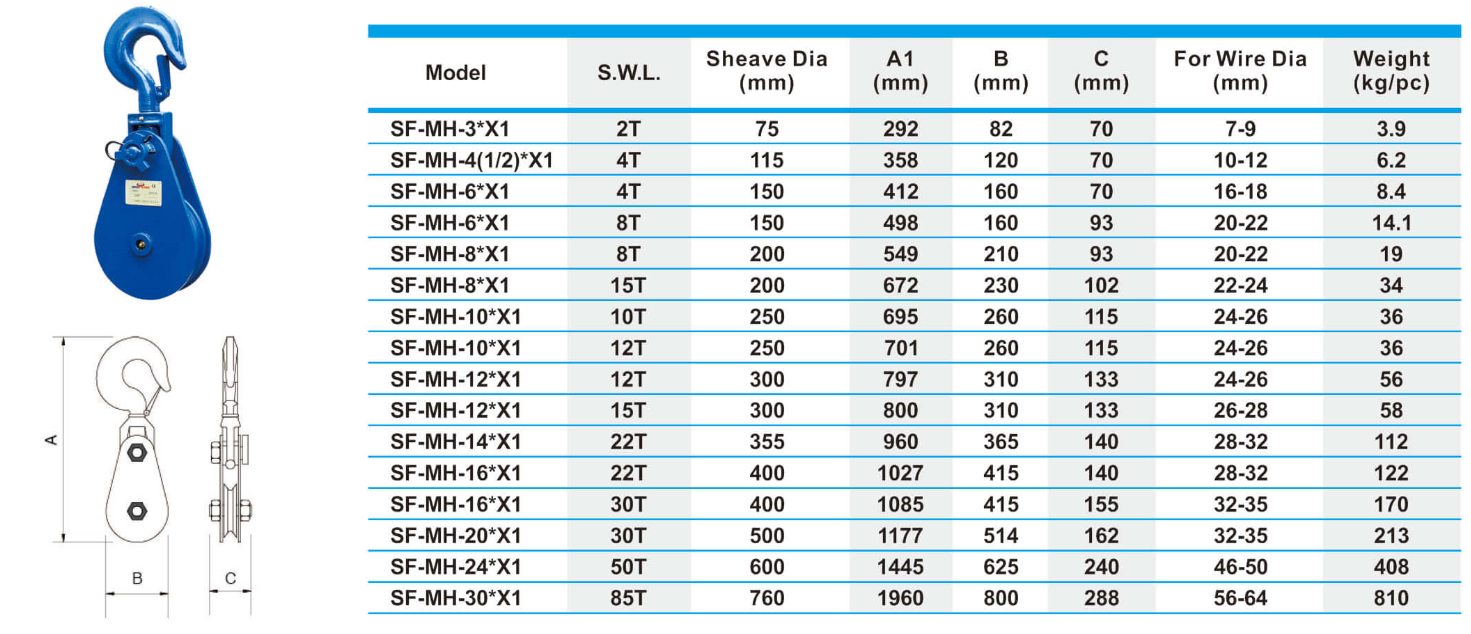
The MLS Series covers Safe Working Loads from 2 to 85 tons and uses a single-sheave construction with a shackle connection. A quick-pull pin allows the side plate to be opened so the wire rope can be placed into the sheave without feeding the complete rope through the block.
Heavy-duty steel construction, forged load-bearing components and a durable powder-coated finish make the series suitable for regular use in industrial, marine, construction, towing and heavy-equipment applications.
Specification | Details |
|---|---|
Product Type | Heavy Duty Snatch Block |
Series | MLS |
Model | SF-MLS Series |
Safe Working Load | 2–85 Ton |
Connection Type | Shackle |
Sheave Configuration | Single Sheave |
Nominal Block Size | 3–30 Inch |
Rope Type | Wire Rope |
Side Opening | Quick-Pull Pin |
Finish | Powder Coated |
Load-Bearing Components | Forged Parts |
Alternative Connection | Hook Type Available |
Brand | SUPER FISHER / OEM |
Customization | Model, Label, Branding and Packaging |
One of the practical features of the MLS snatch block is its quick-pull side pin.
A conventional closed pulley may require the end of the wire rope to be fed completely through the block. With an opening snatch block, the side plate can be opened so the rope can be placed directly onto the sheave.
This is particularly useful when working with long wire ropes or an existing rigging system.
The quick-pull pin can reduce the amount of rope handling required when installing or repositioning the block.
A typical setup process includes:
Remove or release the quick-pull pin.
Open the side plate.
Position the wire rope correctly in the sheave groove.
Close the side plate.
Reinstall and secure the pin.
Check that the pin is completely engaged before applying tension.
The block should never be loaded while the side plate or retaining pin is not fully secured.
A snatch block can be used to redirect a wire rope so the pulling equipment and load do not need to remain in a straight line.
This can be useful when obstacles, machinery layouts or restricted working areas make a direct pull impractical.
The direction and magnitude of the forces acting on the block change with the rope angle, so the block load must be calculated from the actual rigging configuration rather than only from the winch line pull.
The MLS Series uses a single sheave to guide compatible wire rope through the block.
The sheave diameter increases with block size and capacity so the correct model can be matched to the intended wire rope and application.
Correct sheave-to-rope matching is important because a groove that is too small, too large or badly worn can cause poor rope tracking and unnecessary wire rope damage.
Before choosing a snatch block, confirm:
Wire rope diameter
Wire rope construction
Required line pull
Required block S.W.L.
Sheave diameter
Sheave groove condition
Rigging angle
Connection hardware
The rope should sit naturally in the sheave groove without being pinched or riding against the side plate.
SUPER FISHER also supplies other wire rope snatch blocks for different lifting and pulling arrangements.

This MLS configuration uses a shackle at the suspension or connection point.
The shackle connection provides a practical interface between the snatch block and compatible anchor points, lifting eyes, wire rope assemblies or other rated rigging components.
A shackle connection can be useful when:
The block must connect to a fixed lifting eye.
The connection point uses a sling or master link.
The block needs to rotate into alignment with the direction of pull.
A removable rigging connection is required.
Different rigging assemblies need to be connected and disconnected regularly.
The shackle and its pin must be fully secured before the system is loaded.
The connection should be arranged so the shackle is loaded in an approved direction and is not forced into severe side loading.
For separate rigging connections, SUPER FISHER supplies the G-209 High Strength Screw Pin Bow Shackle and other rated rigging fittings.
In addition to the shackle configuration, hook-type heavy-duty snatch blocks are available for applications where a hook connection is more practical.
The correct connection style should be selected according to the anchor point, operating environment and frequency of rigging changes.
Key load-bearing parts of the MLS heavy duty snatch block use forged construction.
Forging shapes metal under controlled force and is commonly used for heavily loaded rigging components because it allows the component geometry and material structure to be developed for demanding mechanical service.
SUPER FISHER uses forged parts in areas where load transfer and mechanical durability are important.
Before use, check the connection and load-bearing components for:
Cracks
Bending
Permanent deformation
Deep corrosion
Heavy impact damage
Elongated holes
Worn pins
Damaged threads
Missing retaining components
A component that has been severely overloaded or visibly deformed should not be straightened and returned to service without proper assessment.
The MLS snatch block uses a durable powder-coated finish on the external steel structure.
The coating helps protect the block body during normal industrial handling, transport and storage.
This is useful in environments such as:
Workshops
Construction sites
Warehouses
Ports
Equipment yards
Marine service areas
Mining operations
Heavy machinery maintenance
Powder coating does not make the block immune to corrosion.
After exposure to salt water, chemicals, mud or heavy contamination, the block should be cleaned and inspected before storage.
Areas where the coating is damaged should receive particular attention during periodic inspection.
The MLS Series covers a broad S.W.L. range from 2 tons for general industrial pulling through to 85 tons for heavy-duty rigging applications.
Different capacities use different sheave diameters, block dimensions and wire rope ranges.
Available capacities within the MLS family include configurations for light, medium and heavy rigging requirements.
Smaller models are suitable for applications such as:
Workshop pulling
Equipment positioning
Construction rigging
Vehicle recovery systems
General wire rope redirection
Medium-capacity models can be used in applications involving:
Industrial machinery
Larger construction components
Marine equipment
Structural installation
Mining maintenance
The higher-capacity models extend up to 85 tons and are intended for applications where larger wire ropes and substantially higher rigging forces are involved.
Typical projects may include:
Heavy equipment pulling
Large industrial assemblies
Shipyard work
Offshore support operations
Mining equipment
Heavy construction
Large-scale towing systems
For high-capacity applications, the entire rigging system must be evaluated rather than selecting the snatch block in isolation.
The load applied to a snatch block is not always the same as the pulling force in the wire rope.
This is an important consideration when selecting the correct S.W.L.
When a wire rope changes direction around a sheave, forces from both rope sections act on the block.
The resulting block load depends strongly on the angle between the incoming and outgoing rope.
If the rope makes a large change in direction, the load acting on the snatch block can be substantially greater than the line pull produced by the winch or pulling device.
For this reason, operators should consider:
Line pull
Angle between rope sections
Number of parts of line
Anchor capacity
Shackle capacity
Wire rope capacity
Snatch block S.W.L.
Do not assume that a 10-ton line pull only places 10 tons of load on the block.
When the load calculation is uncertain, the rigging plan should be reviewed by a competent person before operation.
Snatch blocks can also be incorporated into multi-part wire rope arrangements.
Depending on the way the rope is anchored and routed, a block system can change the relationship between pulling force and load movement.
The simplest arrangement uses the block primarily to redirect the wire rope.
This helps position the winch or pulling equipment in a more practical location.
Additional blocks can be used to create more complex reeving arrangements.
These systems may reduce the line pull required from the pulling equipment, but they also introduce additional forces at:
Anchor points
Snatch blocks
Shackles
Slings
Wire rope terminations
Every component must be rated for the force it actually receives.
Heavy duty snatch blocks are commonly used where wire rope direction, load positioning or mechanical advantage needs to be controlled.
Typical applications include:
Towing operations
Marine and offshore rigging
Shipyard maintenance
Construction
Mining
Heavy machinery recovery
Equipment installation
Industrial pulling
Wire rope redirection
Loading and unloading
Port operations
Utility work
Factory maintenance
Agricultural equipment pulling
SUPER FISHER lifting and rigging equipment is also used across industrial, construction, marine and offshore applications.
For other block styles, the CY Type Single Sheave Snatch Block is available for lower-capacity applications.
Correct product selection starts with the rigging system rather than simply choosing the largest available block.

Calculate the maximum load that will act on the block.
Include the effect of the rope angle and the intended rigging configuration.
Select a block with sufficient S.W.L. for that calculated load.
The sheave and groove must be compatible with the wire rope diameter.
Using an unsuitable rope can increase wear on both the sheave and wire rope.
Larger wire ropes generally require larger sheave diameters to reduce excessive rope bending.
The appropriate sheave should be selected according to the wire rope and application requirements.
Use a shackle-type block when a closed, removable rigging connection is preferred.
A hook-type block may be more convenient where faster attachment is required and the hook configuration is suitable for the application.
For marine, mining or outdoor applications, consider:
Corrosion exposure
Mud and dust
Water
Salt spray
Temperature
Inspection frequency
Storage conditions
Maintenance intervals should reflect the actual working environment.
Before loading the block, verify that the entire rigging arrangement is correctly assembled.
Check the sheave, side plates, pin, shackle and other structural components.
Release the quick-pull pin according to the block configuration.
Place the wire rope into the sheave groove.
Make sure the rope is correctly seated and is not twisted.
Close the side plate and fully secure the quick-pull pin.
Attach the block to a rated anchor or rigging component.
Secure the shackle pin properly.
Make sure the block can align naturally with the applied force.
Do not force the block into a fixed position that creates severe side loading.
Take up slack slowly and observe the entire system before applying full pulling force.
If the rope does not track correctly on the sheave, stop and correct the setup.
A heavy-duty rating does not eliminate the need for correct rigging practices.
Always:
Confirm the block S.W.L.
Calculate the actual block load.
Use compatible wire rope.
Check the shackle connection.
Fully secure the quick-pull pin.
Keep the rope seated in the sheave.
Use rated anchor points.
Apply tension gradually.
Keep personnel away from tensioned wire rope.
Inspect the complete system before use.
Do not:
Exceed the marked S.W.L.
Use an unsecured side pin.
Use severely worn wire rope.
Use a cracked or deformed block.
Side load the shackle beyond permitted limits.
Use an anchor point of unknown capacity.
Stand inside the angle formed by a tensioned wire rope.
Stand close to a loaded wire rope system unnecessarily.
Apply shock loads.
Modify the block or pin.
Replace components with unverified parts.
Wire rope under tension stores significant energy. The work area should be controlled so personnel remain outside foreseeable recoil and failure zones.
Snatch blocks used regularly in towing and industrial rigging should be inspected before use and periodically according to service conditions.
Check for:
Worn groove surfaces
Cracks
Chipped edges
Uneven wear
Restricted rotation
Excessive movement
Rope tracking problems
The sheave should rotate freely without abnormal resistance.
Confirm that the pin:
Is straight
Is not severely worn
Engages completely
Has the correct retaining mechanism
Has not developed excessive clearance
Look for:
Bending
Cracking
Heavy corrosion
Impact damage
Elongated pin holes
Check the shackle body and pin for:
Deformation
Thread damage
Excessive wear
Cracks
Incorrect pin engagement
Moving parts should be maintained according to the applicable maintenance requirements.
Remove dirt, wire fragments, grit and other contamination that could interfere with sheave rotation.
After marine or wet service, clean and dry the block before storage where practical.
SUPER FISHER supplies heavy duty snatch blocks for distributors, lifting equipment suppliers, towing businesses and industrial projects.
OEM and ODM services are available for lifting and metal rigging products.
Customization and project supply requirements can include:
Capacity selection
Model selection
Shackle or hook configuration
Product labels
OEM branding
Logo marking
Packaging
Export documentation
Inspection requirements
When requesting a quotation, provide:
Required S.W.L.
Wire rope diameter
Required sheave size
Shackle or hook type
Quantity
Application
Destination market
Packaging requirements
For heavy-duty projects, providing information about the line pull and rope angle can also help confirm the appropriate block capacity.